Thursday, 15 August 2019

Sheep and stupidity

Many times, people have said to me that sheep are stupid. Many times, I've disagreed.

I have watched sheep solve problems and get what they want. I've seen them learn. They observe other sheep and follow what works.

A neighbour told me a story about sheep and a cattle stop that I won't forget.

A lot of people use cattle stops where a gate is inconvenient or impractical. Further down our road, there is a road that runs through a paddock often with sheep grazing in it. You can't put a gate across a public road, so there are cattle stops at each end.

For those who are unfamiliar with cattle stops, they're a patch of road that contains a series of steel rails set parallel to each other with a gap between them. Animals can't see exactly where they are placing their hind feet and don't like the way it feels to step on a narrow rail.

This neighbours children didn't like walking over the cattle stop either, so he placed a narrow board over it at one side so the kids could get across.

After about a week, he looked out to find the sheep in his garden. They had watched the kids and were going carefully across the board in single file.

So with the exception of the sheep who can't find the open gate because they are trying to follow their friends down the other side of a fence, I've usually said sheep are smarter than you'd think.

Not anymore. I have one hogget ewe who carries wool that is probably smarter than she is.

Today I untangled her from blackberry for the fifth time in about a month.

Because of feed and parasite issues, I've let them loose in the gully. We don't normally graze the gully as it's a mess of gorse, blackberry and honeysuckle. It's on the list to tidy up, and it gets a bit of work now and then, but it's not a priority until the grazing areas are sorted completely. When we do graze it, it's usually cattle because they do a lot of the work for us.

So this daft ewe has tangled herself up a few times. The first two times weren't too bad. Getting fairly close to her was enough to make her panic and free herself. The next two times were kind of one time twice. I cut the blackberry that was wrapped all around her, pulled the majority of it out of her fleece and she ran headfirst into another big tangle, twisted herself around and I had to do it all over again.

On Monday, I went for a walk to check on my sheep. A combination of lousy weather and a visit from my granddaughter had meant I didn't get a chance over the weekend.

I was one short. I was missing the daft brown hogget ewe. I checked all her usual spots to tangle herself up in and couldn't see any sign of her. I chose not to worry too much, she might come out of the gully when I'm not looking.

Yesterday I put Coco the lamb out with the other sheep during the day. I also put out a feed of sheep nuts which usually brings them running.  Still no sign of her.

Today I went for a walk again, and I found her. At first glance, I thought she had finally managed to kill herself, but a closer look showed she was still breathing.

I spent probably half an hour cutting her out of this lot before she wobbled off unsteadily.

I'm putting the pictures out of order because the one that would come up as a thumbnail would probably upset folks who hadn't read it.

Here is the epitome of a stupid sheep.

After untangling 

This is her as I found her 

Thursday, 11 July 2019

Another Mild Winter So Far, Sheep and Parasites

Here we are, approaching the middle of Winter and it's lovely out.  We've had maybe a handful of frosts so far, instead of the usual two months of nearly every day.  The grass almost seems to be starting it's Spring Flush.

As a Summer lover, I should be happy about this.  I much prefer the heat to the cold.  But I'm not happy.  This has caused me issues and worries me about the next month or so.

Many plants that I like to grow need a good freeze every year. 

The volumes of parasites and vermin are usually lowered when we've had a proper cold Winter.

Last week, half my sheep went down scouring.  I had to physically pick them up off the ground where they'd become cast, my old ram took four or five attempts before he could take more than one step and collapse again.  Several had become quite skinny, with spines and hips showing through their thick Winter fleece.

My Wonderful Neighbour recommended opening up the gully for them, as there was plenty of good grass in there and if they've got good grass in the open, they should be less likely to get stuck in the blackberry.  Give them some hay right now, it will bind them up a bit.  He also recommended drenching with a double dose for the scouring ones.

I went out with a bale of hay and split it between my two flocks.  That's when I found Lenny.  I thought he was dead.  He was down, scouring and the magpies had been pecking at his eye.  I got him at least on his belly, instead of his side and surrounded him with hay.

I went to our farm supplies store and had a lovely long chat with the lady there.  She recommended pouring pineapple juice into Lenny.  They love the taste and it's filled with sugar.  That should give him some energy to be getting up and about.  Give them sheep nuts too.  And this drench is good, it also contains a dose of minerals, don't double dose any of them.  Leave Lenny until tomorrow.

The general consensus is parasite numbers have gotten very bad as a result of our third mild Winter in a row.  Usually a few decent frosts will kill off 95% of the worm eggs and larvae in the grass.  The lady at the farm supplies store also said there seems to be a new worm around.  Bigger farms than mine with far more experienced farmers have been having issues with their sheep suddenly going down.  Enough for them to call vets in.

I also got Cider Vinegar to go in their water troughs.  I have used it for years without any problems, mostly because until a year ago, I didn't have yards to contain and drench my animals.  The vinegar kills most parasites and the parasites don't become resistant to it.  I hadn't dosed the water troughs in months though, partly because I'd run out and forgotten that I'd run out and partly because I'd just spent six weeks not allowed to lift a finger for myself (recovering from surgery) and so most of the little things I would normally see and do had started to slip.  Hubby did a wonderful job milking the cow and feeding the chickens, but he doesn't have the habit of looking out into the paddocks as he's doing the chores and he doesn't stop and do a head count of the sheep when he can see them.

I poured pineapple juice down Lenny, I gave him sheep nuts.  I went back to check on him frequently and eventually got him up and moving.  It was slow and painful, but I was able to get him under cover on a bed of hay and with a handful of sheep nuts to munch on.

The next day I went out to drench them.  I found one of my wethers down and scouring. I drenched him while I was picking him up.  He bounced back rather quickly. I worked my way through the rest of my animals, although I couldn't get one of my ewes into the yards.  She wouldn't follow the rest of her flock, she ran into the old turkey shed in the next paddock (we were running them through this one to get to the yards) instead.  Since the shed has a narrow doorway, Hubby went into the shed to try to catch her and I blocked the doorway.  She ran full force, grumpy, stroppy force, into my kneecap.  I still have a nasty bruise.  I managed to pin her against the side and drench her there though.  I had to pick a couple of the hoggets up, but they kept going once they were up.

Lenny was up and about.  He seemed to spend the day going from the water trough to the bin of sheep nuts and back again.

I spent a couple of hours reading up on parasites and learning about their life cycles, which animals are more prone to them and under what conditions.  There's a wonderful resource available as a pdf that you can find here. It gives you more information than you probably ever wanted to know, but much of it is very useful to someone like me.

The next morning, Lenny was down again and not able to get up.  I tried picking him up, but he couldn't quite get his feet under him.  The wounded eye was weeping.  He'd stopped scouring and seemed a little bloated.  I poured more pineapple juice down him.  He seemed quite keen for it, although his tummy was making some alarming noises after he'd finished.

After I'd finished the pineapple juice, I went back every few hours to give him some electrolytes.  I thought they'd give him the nutrition he needed while allowing whatever was bothering his stomachs to pass. The last time I went out, late in the day, he'd gone.

I've become pretty good at not taking livestock deaths personally, but I cried.  I'd just fought for three days to keep him alive and I failed.  I'd only had Lenny for a few months, he came to us as a fat pet hogget and we lost him.

I've had a few conversations with people who know more about sheep than I do (nearly everyone who has sheep) and there have been a few suggestions floated.  One is that my sheep are mostly immune to whatever bugs we have here and he wasn't.  It affected him the most because he'd come in from elsewhere.  Another is that he brought the new bug with him.  Another is shit happens, if you have live stock, you have dead stock and you can't win them all.

Sigh.  I just hope that we have his offspring brewing in the girls he'd been running with.

Now.  I'm going to take you back in time by a week.  Yes, I know this is out of order, but bear with me.

The week before, I was out trying my hand at doing my animal chores with help and supervision (mostly in the form of "don't lift that") from Hubby.  I glanced out over our paddocks as is my habit and asked, "Is that a dead sheep?"

We went for a walk and found Molly, one of my older ewes.  She was alive, but on her side and the hawks had been attacking her face.  She showed no signs of scouring.  I tried to get her on her feet.  I failed.  I turned her around at least so her head was uphill.  Her gums were white which isn't a good sign.  She was skinny but not scouring.  I tried to tempt her with handfuls of fresh grass and electrolytes, but we lost her.  It's been suggested that she might have had a heart condition or something - the lack of scouring removes many diseases from the probable cause of death list. 

I moved the other sheep from her paddock, and in doing so found an abandoned lamb.  Two of my ewes showed signs of having lambed, Nibbles had a healthy fat white lamb running around her and Peg had blood down her back legs and tail. Nibbles' lamb looked to be a couple of days old and this one was brand new, bright fresh navel string and all.  I picked it up and took it over to the sheep, it bounced around crying and tried to feed off most of them.  They all either ran away or beat him up.

I took him up to the house and made up a bottle.  I thought maybe give him a good feed and then take him back and see if Mum will take him then.  I was fairly sure he was Peg's, but she had hardly any udder and was looking a little rough too.  Each time I took him near the sheep, they'd run away or knock him over.  And then he'd follow me around head-butting my legs and tripping me up.  I gained a pet lamb.

My darling granddaughter Miss Two named him Coco and he's still doing fine.  He outgrew the box in the lounge rather quickly and had to move out to the pen in the milking shed - hastily cleaned up to remove the last of the pig poo and a bed of hay laid down.  So to cheer up a hard post to make, here are some pictures of Coco. This is why he came at the end.


Two days old, exploring the lawn and garden.


At about a week old, in the shed.

Wednesday, 29 May 2019

Meet Lenny

Lenny


For the past year, I have been thinking about the situation with my sheep.  Ramuel Jackson is now the sire of half of my ewes.  Opinions differ on whether inbreeding fathers over daughters is okay.  It seems to be a standard practice in some areas, or ignored until lambs start showing deficiencies. 

I have issues with this.  I personally find such inbreeding distasteful and try to avoid it.  I know that the sheep probably don't care, it's my issue.

The first and obvious solution is to get a new ram. 

But what to do with Ramuel Jackson? I could try to sell him, but I can't give many details at all about him.  I don't know his age. I don't know his breed for certain, the best I can do is go by my shearer's guess that he's a Romney.  And not that many people are interested in a coloured ram.  I'm too much of a soft touch to have him slaughtered for dog food.

It had occurred to me to split my flock.  Ramuel could continue to service my older ewes.  They're all white and not related to him.  While his daughters could run with a new ram.  This would mean the new ram's flock would continue to grow every year but I would have to find another solution for the new ram's daughters as they'd be Ramuel's granddaughters. 

I have dithered, undecided for far too long.

Then recently I saw a post on facebook offering two young rams for sale.  They're two out of a set of triplets, purebred Suffolk and fine looking boys.  I did some quick research about the Suffolk breed.  Good hardy sheep, mostly meat producers and their wool is approximately mid-range for fineness, rating better than Romney.  I enquired, we chatted and a week later, Lenny arrived.

Lenny is friendly and has been almost a pet.  His previous owner was a little sad to see him go, although she accepted that she couldn't keep him.  Both he and his brother Benny had been showing interest in their ewes, all of which they were related to.

I think she felt a little hurt at how he ran to the fence, calling to the ewes in another paddock and wouldn't come back to say goodbye, but at the same time I think she was relieved to see him so happy to meet some new sheep.

We hadn't split our flock before his arrival.  So while we kept Lenny in the paddock he arrived in, we ran the others through our new yards. We also separated last years wethers from the others to make it easier when we call the homekill man in.

Lenny and his girls
Lenny was ecstatic with his new girls, doing his job before we'd even started moving them into their paddock.  By the time we had Lenny and his little flock in their paddock, he'd already formed a special friendship with Beyonce.

We're looking forward to seeing what kind of offspring we get this year from Lenny.
Lenny and Beyonce

Friday, 29 March 2019

Sweet Chilli Sauce

Hubby loves sweet chilli sauce.  Last year he asked me why I don't make it for him.  Well, um, I guess it's because we don't grow chillies?

So we bought some chilli plants in spring and Hubby planted them among the capsicums and tomatoes.  He thought he'd kept hold of the labels telling us what type of chillies and peppers we'd bought, but it would seem not.  Or if he did, we have no idea where they've gotten to. We seem to have a mix of banana peppers, bell peppers, long red chillies and some that look like a small bell pepper - a little smaller than a golf ball.

Since the chillies have started ripening, I looked for recipes for Sweet Chilli Sauce.  I found one embedded in a blog that seemed great on the surface, but as I got deeper, it used Sambal Oelek, a pickled chilli jam, that I don't have, instead of chillis which I do have and want to use. Using them was kind of the point of the exercise. So I carried on looking.

I found one on Taste.com.au, it seemed simple enough so I thought I'd try it.

The only problem was the proportions.  My seven chillies weighed a grand total of 40g, the recipe called for 500g.  That was quite a bit different.  So I added approximately 60g of capsicum to make it up to 100g, much easier to convert the recipe then.

It cooked up quite quickly, I didn't simmer it for the full 30 minutes in the recipe and ended up with about a cup of hard chilli jam.  A very hard chilli jam that was almost inedible.  The tiniest bit on the edge of a teaspoon was enough to set your mouth on fire.

So I left it overnight while I considered my options.  Today, I blitzed up two whole bell peppers and made it up with the full amount of white vinegar and sugar in the recipe, as the sugar dissolved, I added my hard fiery chilli jam from yesterday and stirred it around until it dissolved too.

After a taste test, I added more sugar.

We've tested it tonight and it's sweet and it's spicy.  It's got a nice bite of heat to it without being overpowering.

So now I'm watching my chilli plants so I can make more.

Sweet Chilli Sauce

50g hot chilli peppers
2 whole red bell peppers
3 large cloves garlic
750 ml white vinegar
3 1/2 cups white sugar

Halve and deseed the chillis and peppers.  Put into food processor with garlic and a little vinegar.  Blitz until almost pureed. Put into a saucepan with the remaining vinegar and sugar.
Heat slowly, stirring constantly until the sugar has all dissolved.
Bring to the boil, then turn down heat and simmer until it starts to thicken. Taste test and add sugar if needed.
Be careful not to allow it to thicken too much - the sauce should still run freely when cold.


Tuesday, 19 March 2019

Doing Things With Peaches!

A workmate and good friend of Hubby's has a very prolific black boy peach tree.  Every year we're given peaches and when we have pigs, buckets of bruised and windfall peaches.  Have you ever seen a pig eating these?  It looks like they've been taking big chunks out of each other, dark purple-red peach flesh dripping down their jaws.  It's really quite disturbing.


Hubby got these on Friday, the same day as his motorbike came back from the shop.  Our plan was for him to bring the motorbike home and as I was going into Christchurch for the weekend, I'd drop him back at work Friday night to bring his car home.

With the Mosque shootings on Friday afternoon, all those plans changed.  We didn't go back for the car (with a bag of peaches sitting in it) until late Sunday afternoon.  Probably half of the bag has gone to the chickens and they look just as dreadful eating them as the pigs did.

So today I started to do things with peaches.

Previously, I have bottled them in a light syrup.  I think I still have a few jars in the depths of my pantry, we don't eat fruit this way very often.  A few years ago, I cut them up and froze them.  They're still there in the freezer too.  I have to move them now and then searching for other things.

I wanted something I was sure I would use.

Out came the recipe books and searches through their dessert chapters.  The old books, which are usually my go-to for anything like this, yielded nothing that excited me.  I considered the peach souffle, but as I've never made a souffle of any sort in my life before, I chose to try it another time with a simpler version.  Peach Flummery sounded interesting, but I didn't have enough cream or gelatine on hand.


Into the bigger, flasher and newer cookbooks I dove.  One had peach muffins.  The next had a peach crumble.  We like crumbles, they're simple and easy and adaptable.  I can freeze them.

The original recipe and inspiration came from River Cottage Gluten Free.  I'm a little wary of this book these days.  I made a cake from it about six months ago that had a lot of 'mix x, y and z together in a small bowl, then put aside'.  Six different bowls and a saucepan were required for this cake!  The cake was okay, but not anything overly special. So I read through the recipe carefully, looking for sneaky over the top dish usage.

I didn't have all of the ingredients, but crumbles are fairly adaptable.  Below is my interpretation.

Peach Crumble

Peach Filling

Approx 800g peaches, stoned and cut into chunks.
Brown sugar to taste (depending on how sweet the peaches are)
30g butter

Crumble Topping

150g hazelnut meal
75g brown sugar
30g sorgham flour or psyllium husk
30g potato starch
1 tsp ground cinnamon
60g butter

Preheat the oven to 180 deg Celsius.

Put the filling ingredients into a saucepan. Heat gently until the peaches have softened and the butter and sugar have formed a thick sauce.

Put the dry crumble ingredients into a food processor and blitz to mix.  Add butter and process until butter is fully rubbed in.

Pour or spoon filling into dish and spread crumble over top.  I like to get handfuls of the crumble and sprinkle it around and around until the fruit is completely covered.

Bake for 40 minutes.  Best served warm.


Thursday, 14 March 2019

Birds and Fruit

Our Summer has been pretty dry and harsh this year.  I don't think we quite managed drought status and our humidity has been much higher than is normal.  Our temperatures have certainly been up there and I think officially it was the third hottest on record.

This year though, the birds seem to be struggling.  Their numbers appear the same, (despite having outdoor cats) but their preferred diet seems to have changed.

We will have no grapes this year.  We had masses of bunches as they were growing.  They are only just ripening now, there's the faintest hint of purple starting to show and there are maybe 5 bunches left.  When you go anywhere near the grapevines, at least 10 blackbirds and thrushes fly out from it.

We didn't get any nectarines.  They weren't ripe yet either.  I think it took the birds about a week to clean an entire tree out.

My little apple tree was doing well.  The apples were ripening and I'd been picking a few as they reddened.  I was giving the small ones or partially eaten ones to the horse next door.  He'd wait for me by the fence every day on my feeding rounds, patiently eyeballing me and pointedly looking at the apple tree.  There were about 20 left, mostly looking about ready to pick, so I decided that was tomorrow's job.  Only the next day there were 4.  I could only see 3 cores and remains on the grass beneath the tree.

If it wasn't for all the birds visibly attacking my bigger apple tree, I would have believed that someone had come and stolen them.  My bigger apple tree was losing at least 15 whole apples a day.

We missed out on the plums.  Strong winds took care of them.  The late winds also took the first apricots we've ever had off our young tree.

I've never seen anything quite like it.  Well, I've seen the grapes go to the birds before, but not the other fruit and certainly not the way they're cleaning them up completely.  I haven't decided how much I begrudge the birds my fruit.  I, at least, have the option to go and get it from other sources.

Thursday, 7 March 2019

Easy Cheesy

There are a few simple and quick cheeses that anyone can make.  Here I've given recipes for my favourite three.

These cheeses don't require culture or specialised equipment, most ingredients are things that can easily be found in the average kitchen.

Be aware that your finished cheese will be about 10% of the milk you start with.  If you start with 2 litres of milk, you can expect approximately 200g of cheese.

In the first two recipes, the curdled milk should look like this.


Queso Blanco

Queso Blanco is very much like ricotta, in the process and in the finished product.

Bring milk to the boil, stirring to avoid scorching as much as possible.  Very slowly pour in white vinegar, while stirring, until milk curdles and separates.  Make sure that it has separated completely into white fluffy curds and green whey.  If it's just like grainy thick milk, add more vinegar and keep stirring.

Let sit for about two minutes then pour through a cloth lined colander.  Strain until there is no more liquid to come out.

Add salt, garlic and/or olive oil to taste and use like ricotta.
This doesn't keep very well, I'd recommend using it within a week.

Cumin Paneer

I make this one often for my Hindi friends.  I'm told it can be frozen, but I haven't tried freezing it myself.

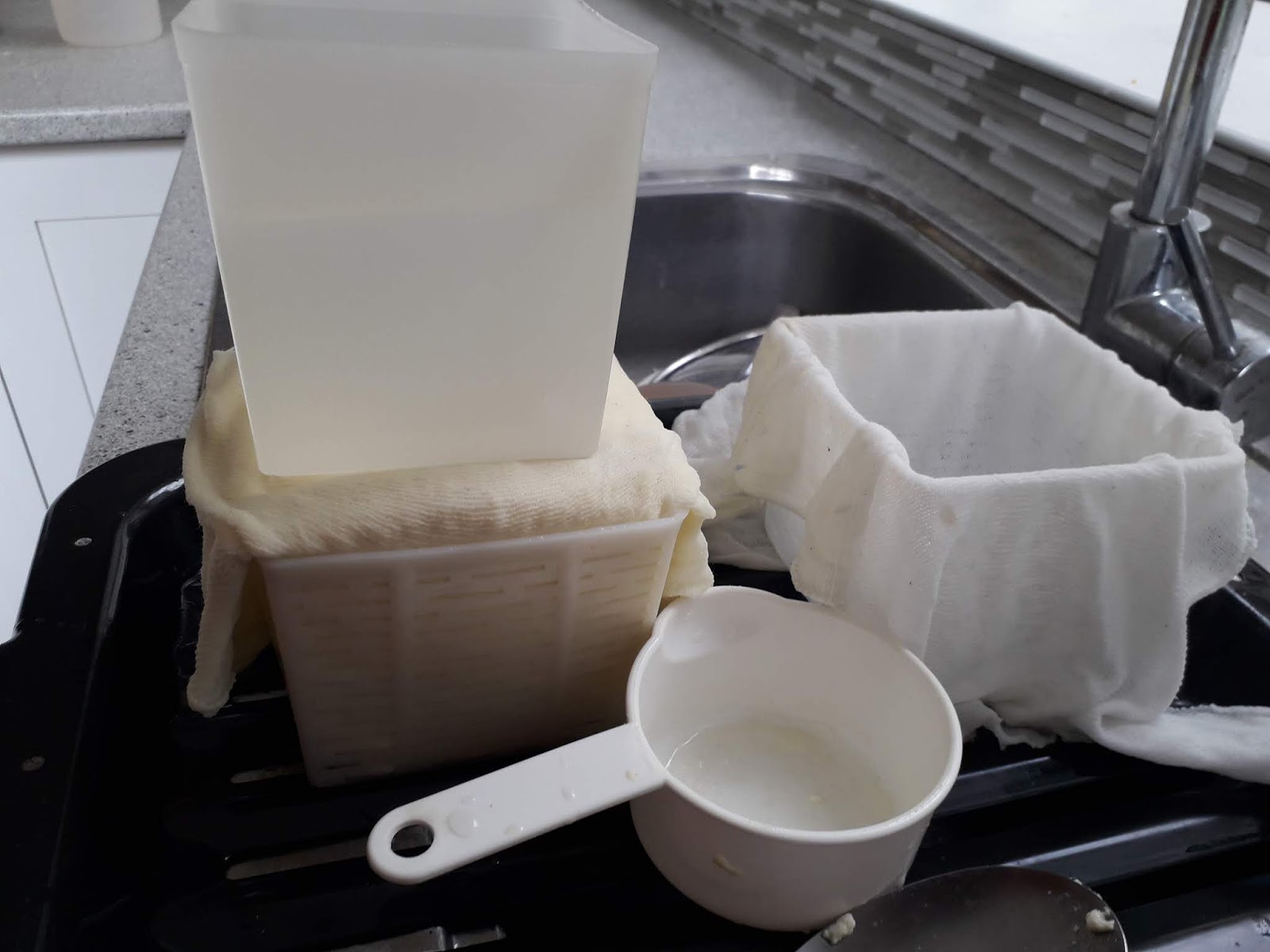
The recipe I started with said to strain it through a cloth lined colander, twist the cloth around and weight it down.  This made the finished cheese a rounded ball.  My Hindi friends are used to buying it in a square shape, and say this makes it easier to cut into cubes and use.  My solution was to use a cloth to line a feta basket and make cube paneers.

The addition of salt and cumin not only gives this rather bland cheese some flavour, it extends it's keeping time.  This should stay good for about 2 weeks.

My original recipe used lemon juice.  I found myself out of lemons at one point, but my lime tree was so prolific, they were falling all over the ground underneath the tree.  So I tried lime juice and it has worked just as well.

For every 2l of milk, add a tsp of non-iodised salt and a tbsp of cumin seeds.  Bring to the boil gently, stirring constantly to minimise scorching.  Let it boil for 3 minutes before adding lemon or lime juice.  Pour citrus juice in slowly until milk curdles clearly into white fluffy curds and green whey.

Ladle into a cloth lined colander (or cloth lined feta basket).  It may take some time for it all to settle, so be prepared to come back every so often to add more, but try and get it all in while it's still hot.

Fold cloth over and turn upside down in the basket.  If you can find something square to weigh it down, this makes a better, firmer cheese.


Mozzarella

True Mozzarella is made with buffalo milk.  This recipe uses ordinary cows milk.  This recipe also requires liquid rennet.  There are several varieties available in more places than you'd think.  I often buy mine from Bin Inn (various cheese cultures and equipment can also be bought there) but there are plenty of websites that sell rennet fairly cheaply.  Make sure that you are buying either calf rennet or vegetarian rennet and not junket rennet.  Junket rennet is often sweetened although most modern recipes for junket seem to use normal rennet.

I found that mozzarella doesn't keep very well, so I grate it and freeze it in zip lock bags.  This makes it easy to use on pizza and the like.

For every 2l of milk, you will need 1/2 tsp of citric acid.

Dissolve citric acid in 1/4 cup of lukewarm water and stir into milk.  Heat milk to 31 deg C, stirring gently to prevent scorching.

Dilute 1/4 tsp of liquid rennet in 1/4 cup of cool water, add to milk and stir in gently.

Cover and let set for 30 mins.

Check for a clean break.  This means run your knife through the centre of your curd and then either lift the split or pull to one side.  If a clean break has been achieved, the two sides should part easily and hold their shape.  The curd won't be firm, but will hold.  If the curd seems a bit soft or not set, let it sit for another 15 mins.

Using a long bladed knife, cut the curd into half-inch cubes.  I cut front to back and side to side, then turn my knife onto a fairly steep angle and cut the horizontal lines on an angle. I go back and forth with the knife about half an inch deeper down the side each pass.  It doesn't make true cubes, but cuts them into roughly the right size.  I turn the pot and do this four times to be sure I've got them all. Let stand for 5 mins.

Place pot over low heat and slowly bring the curds up to 41 deg C, making sure it takes 20 mins to get there.  The curd will have cooled slightly from it's original temperature, but you're looking at approximately 1 degree raised every two minutes.  Don't let it warm up too quickly. Stir constantly while heating.  Turn off the heat and stir for another 20 mins.  Let stand for 5 mins.

In another pot, bring fresh water to the boil.  At least 2 litres but 4 often works better.  Add non-iodised salt at a rate of 1 1/2 tbsp per litre and stir until dissolved.

Drain whey from curd through a cloth lined colander.  Let the curds drain for 15 mins.

Place curds onto a clean chopping board and cut into 1 inch strips.  Place into a large bowl and pour hot salted water over.

Wearing heat resistant gloves, or using a wooden spoon, work the strips under the water until they become soft and pliable.  Knead, pull, stretch and fold it back on itself.  Keep working until the cheese becomes long and stretchy, it will also become shiny and smooth.  Work all the strips into a single large ball or into small bocconcini sized pieces.

I found another recipe that recommends microwaving the curds in 30 second bursts until an internal temperature of 72 deg C has been reached.  I have used this method and it works, but can be messy and frustrating.

Place the cheese into a bowl of ice water for 5 mins. Drain on a paper towel.

Enjoy simple cheese making!