Thursday, 15 December 2016

The Chick With Two Mums

Every year several of my hens go broody.  Every year I get excited and watch for signs of chicks.  Until now, every year I’ve been disappointed.  I’ve heard so many theories about why it never happened.

Howard, our first rooster was a bantam, he arrived with his mother Mrs Wolowitz.  I called him Howard after The Big Bang Theory character because of the way he’d sidle up to my hens (who generally were bigger than him), do a little dance and try to jump on.  He didn’t give up even when they wouldn’t have a bar of him, he’d puff himself up until he nearly exploded and keep on trying.
The dog killed him.  I’ve since trained the dog to leave the chooks alone, he was still a puppy at that stage and would chase anything that ran.

Then I bought Captain Jack.  A big beautiful Australorp rooster.  I still got no chicks, but only Mrs Wolowitz, my little bantam hen, ever got broody and she’d change which nesting box she was sitting in every couple of days, so there was never any chance of eggs hatching.   I got a few more hens and was given Midnight - another big beautiful Australorp rooster.  Midnight and Captain Jack didn’t get along.  I spent several hours cleaning up the blood and cleaning Midnight’s wounds.

Captain Jack (after the fight)

Captain Jack died, not sure what from, so Midnight became cock of the walk.  By then though, he was servicing 50 hens.  I was told that he had too many hens and that the ratio should be somewhere between one rooster to 6 hens up to one rooster to 10 hens (depending on who you talk to).  Dad said to look at the condition of my rooster, if I had too many hens, he'd be in poor condition and thoroughly hen-pecked (the origin of the term is a literal thing).  He was always fully feathered and looking fantastic, all showy and glossy and proud.

Midnight after the fight


Last summer, one of my hens sat from September until late March to no avail.

Then we got two new roosters with the turkeys.  Roofus and Rory.  They found their way into the chook run with my old girls, although it took Roofus about two weeks of roaming free (and crowing from about 4am outside our bedroom window) to find his way in to meet the girls and Midnight.  They all seemed to get along okay, so I figured that three roosters to 50ish hens was a much better mix.

Roofus (in the middle)


Rory

Midnight died - probably from old age and then there were two.  We lost a few hens along the way as well and were down to 43 ish - they are hard to count.

My hen that sat for 6 months went broody again and for the first time in several years, I was feeling hopeful.  She's been sitting for about a month and was joined in her nesting box about a week and a half ago by another hen.

On Monday I was excited to see we had a chick hatched.  I called Miss Eleven in to see and she was quite excited by it too.
On Tuesday, that chick was dead.  Not sure how, but it looked a little flattened.  There was another that had only made it halfway out of it's shell and never got any further.  

I could have cried.  Although chose to remain excited about it since this was the closest we'd gotten in five years and five roosters.

On Thursday there was a new chick, living and peeping at us.  I wasn't going to get my hopes up.  I cautiously checked in on Friday and it was still alive, in the corner of the nesting box.  Both hens that had been sitting suddenly got all worried and both came back and sat on it, glaring at us.  It had made it to two days, I was more hopeful.

Today (Saturday), it was outside with both Mums, neither straying far and both making their special "talking to baby" sounds.  I can't be sure which of them was the one that sat for the whole duration since they're both Barred Rock hens and close to identical.  I thought maybe that "I will cut you" expression I had been getting from the one who was broody for longer would give it away, but she seems to have lost that now that she's hatched a chick.


I also thought that maybe the newcomer would continue to sit on the remaining eggs in the nesting box.  I was wrong, she can't bear to be parted from the chick either.

Meanwhile, we have a chick with two Mums.


Monday, 21 November 2016

Taming the Triffid Garden

My vege gardens have had their various successes and failures in the last few years.  This year though, I've been determined that we need to have a successful garden.  There is an extra motivation for this, well several motivating factors to be honest.  The first is that my parents have moved into a retirement village - my mother's dementia or alzheimer's (seems to depend on which Doctor you talk to) has worsened to the point where the village was the sensible step for Dad - he won't put her into full time care and the village has a dementia unit if she does worsen too much or if something happens to him.  Dad asked if he could have a patch for veges, but hasn't had the time to come out and do anything with it yet, so we'll just grow enough for them too.

Recent earthquakes and the American election make a lot of things seem unstable so making sure we have the resources to feed ourselves healthily becomes more important.

Last year, I had great success with my broccoli.  I always leave it after I've cut the main head off and pick the side sprouts.  Side sprouts are usually bite sized, but if you keep it up, you can get a few extra meals out of them.  Last year, those side sprouts grew to be only just smaller than a normal head of broccoli, so I got at least ten heads per plant.  They also just kept on growing, the sprouts getting a little smaller as they went until I just didn't bother anymore and I left them to go to seed.  I only stopped them from doing that about a month ago when I decided it was time to start sorting out that garden for this year and pulled them out.

Within a couple of weeks, baby broccoli plants were popping up everywhere.  There has to be at least a hundred self-sown broccoli plants in that garden.

I left the remainder of my spring onions last year to go to seed as well.  They're still flowering so we'll see how well that goes, but they still haven't died off since last summer either.  I also have silverbeet and what I thought was the red stemmed version of silverbeet but has turned out to be beetroot - so I'll leave them to seed and look after the babies a little better.  At the moment, I just pick the leaves and stems as treats for cattle and chickens.

This was the garden that we put several hours of work into yesterday.  The weeds had also bolted, to the point where I couldn't even see the tomatoes that Hubby had planted in there.  They're now clear, staked and laterals removed.

I wish I'd taken a before picture for comparison.


I filled one of the gardens with chicken manure and sawdust (the sweepings when I cleaned out the chookhouses) at the start of last year - nearly two years ago.  Everything grew very fast and very tall.  Too fast and too tall in fact and most of it bolted straight to seed.

All the brussels sprouts I planted last year bolted to seed immediately and I'd left them to seed.  That patch of garden also had radishes that had also bolted and the seeds had grown and then bolted too.  I started cleaning the flowering radishes out and found a heap of small brussels sprouts plants.  Because they had been tucked in amongst a lot of much taller plants, I've been slow weeding that garden, giving each handful I uncover a few days to toughen up before exposing them completely.  I haven't seen what is growing deeper in that patch, because I'm afraid of stepping on a baby plant, but I am working slowly through it.

In the other main vege patch, we planted some potatoes probably a month ago.  Two weeks ago, I mounded them up with year old cow manure.  Hubby had planted out some tomatoes in between the rows of potatoes.  He was sure he'd left lots of space between them, but I was starting to mound them too with the potatoes.  In a week, the potato plants had grown to over a foot above the mounding I'd done.  I don't want to risk using more cow manure in case it ends up too nitrogen rich which would mean lots of plant, but a few small potatoes, so I'm finding some rather sour old clay soil to do the next layer of mounding.


We still have 60 odd seed potatoes waiting or us to plant them, so we're filling tyres again.  And I still need to figure out where I'll be planting peas and beans.


Wednesday, 16 November 2016

Earthquakes 14 November

As you may remember, we moved to our lifestyle block after the devastating Christchurch earthquakes of 2010 and 2011.  Generally, we feel the odd quake, but only mildly and very few of the quakes that hit Christchurch.

So when we were shaken out of bed just after midnight this morning by a 7.5 magnitude earthquake, it was both familiar and a rude shock at the same time.  However, having been there before, I found that while the quake was still rocking and rolling us around I had already assessed how much food we had, how much water was available, our ability to cook and keep warm.

It was somewhat satisfying to realise that because of our efforts towards self-sufficiency we would be okay for quite some time.

We recently had two cattlebeasts and two pigs slaughtered, so the freezer is full of meat.  I also have several male turkeys that are overdue for slaughter, so there was always that available too if the power went out and we didn't want to open the freezers.  My veges are starting to grow well for this season, but except from some neglected carrots and silverbeet that has become triffid-like, most of it is still in the early growing stages so that would be a little tough, but there was still some of last years broccoli and cauliflower in the freezer.  I've also got shelves and shelves full of various preserves in the pantry.  We'd be okay for food.

We have a 900 litre header tank on the roof full of water, a 2000 litre tank up the hill and there is always the water in the creek although that would take some boiling. We'd be okay for water.

We have the coal range for heating and cooking if the power goes out.  We have plenty of firewood in the shed already and there is a lot of old gorse wood in various spots around the farm.  We have gas barbecues and gas in the bottle.  We'd be okay there.

We have tents and shelters and sheds.  We have jackets and gumboots hanging up outside the door.  We have torches galore.

We were going to be okay.


Monday, 5 September 2016

Lemon Curd

In my last post, I mentioned that I give something I've made back to the person who gave me their excess.  Unfortunately (or fortunately I suppose, depending on how you look at it), giving lemon cordial back to Mum and Dad resulted in another bag of lemons.

I'm all out of bottles for cordials, I still have more than enough cordial in the pantry to last us at least a year.  So this time, I made Lemon Curd.

I've found many recipes for Lemon Curd, although sometimes under the names of Lemon Honey or Lemon Cheese, but they're all very close if not the same recipe.  Even going back to the one I found in my Great-grandmother's recipe book from the early 1920s.

If sealed properly, Lemon Curd will keep for months in the pantry and years in the fridge.  Seriously, I just finished a jar of lemon curd that I made 3 years ago and it was still perfectly fine.

In my experience, this recipe will make approximately 500ml of curd - roughly one jam jar.  Increase it by how many jars of curd you want to make.

Lemon Curd


2 lemons
2 eggs
4 tbsp butter
1 Cup sugar.

Lightly beat the eggs.  Grate the lemon rind and juice the lemons.  Add all ingredients together in the top of a double boiler and cook gently until thick - don't let it boil.  Bottle.

It's really that simple.


Lemon Cordial


I've been given lots (and I mean lots) of lemons.

I'm the person people give their excess to, because I can always find something to do with it.  Sometimes what I do with it isn't particularly successful, but I learn from my mistakes and make something better next time.  I also make a point of giving something I've made with the various excesses back to the people who gave the original source material to me.  If that's not practical, I give them something else instead.


At the moment, it's lemons.

I started with lemon cordial.  It's always useful to have, it's great hot for coughs, colds and flu, and it's refreshing as a cool summer drink.  I've used a recipe that was given to me by a friend, she got it from her grandmother who used to make it every year and swore by it at the first sign of a sniffle.

It was nice, but I didn't find it particularly lemony.  You can kind of taste the lemon in there, but it's mostly a sweet drink.

This year, I decided to increase the lemon content in the recipe - partly for that lemon taste and partly as a way to get through those lemons.  The result was a strong lemon flavour, but it's still a sweet drink.  My family love it.

Lemon Cordial


4 litres hot water
4.5 kg sugar
75g citric acid
30 med-large lemons
1 or 2 oranges (optional)

Squeeze lemons and orange.  Dissolve sugar and citric acid in hot water.  Leave to cool before adding juice (boiling water will kill all vitamins).

Lemon zest may be added for a healthier (and stronger) option.  Add while syrup is quite warm and leave overnight or until cold.  Strain before bottling.

This made about 7 litres of cordial.


Sunday, 4 September 2016

Turkey For Dinner

Warning:  This blog deals with killing and dressing a turkey - some pictures and other parts may be upsetting to some people.

Since we got our 16 turkeys, the plan has always been to eat most of the boys.  I've been making enquiries about swapping a couple of boys with someone else so I can have some that are unrelated to mine, but the person I was talking to is overseas on holiday at the moment so that's all on hold.

The need to thin out the ranks has become more obvious lately as it's the start of their breeding season.  There were two of the smaller boys spending most of their time hiding in the house and their normally bright faces were blackened - I don't know if that was bruising or because they'd had their faces in the dirt often.  They were consistently chased away from food and from the rest of the flock.  There is always a layer of feathers, mostly tail feathers, on the grass in their pen.

I've heard lots of varying ideas, stories and opinions about killing a turkey.  Most seem to go with breaking their neck, either by the picking them up by their neck and sharply swinging the bird, or by holding the bird by it's feet, pulling the head down at an angle sharply.  The other method I'd had recommended is to cut it's head off, although after watching an episode of something on tv where the guy who did that had his stomach cut to ribbons by the thrashing around that immediately follows, I was wary of this and had a plan if this did become the way we did it.

Several times over the last two weeks, I've geared myself up to go and kill a turkey.  I've never actually directly killed anything bigger than an insect before.  That's not true, I've been fishing, and held the salmon I caught while it was hit on the head with a hammer.  But I wasn't sure if I could do it.  I'm fine watching someone else do it, I'm fine with the thought of doing it, but doing it myself is a different thing and I believe you never really know until you're there doing it.

The turkeys are brave enough around me to stick their heads into the bucket of food I'm holding when I go into their run, but I haven't been quick enough to get them, perhaps that was some of my hesitation about having the nerve to do it, perhaps it was fear of doing it badly or perhaps it was fear of getting hurt by them.  I've been hit in the face by a wing and that hurt me, if there were flying feet (which are big and sharp and pointy by the way), it could be very messy.

Yesterday, hubby came with me to feed them.  I suggested turkey for Father's Day dinner tonight.  My parents are coming out for dinner, so it could be a point of pride for me to be serving one of our turkeys that we'd processed.  Catching one was the first problem.

Eventually, we herded one into their little house.  We caught him, but it turns out that breaking their neck is not the simple or easy process it's usually been described as.  I think in the end, we broke his neck, but it didn't kill him.  He was still gasping and blinking and we had a very subdued and silent walk up to the house to chop his head off as quickly as we could.  We were both feeling rather cruel in that we'd obviously incapacitated him, but not killed him quickly or cleanly.

I tied his feet to reduce the ability to thrash and potentially injure one of us and we laid him out on a large flat tree stump.  Hubby wielded the axe and my best laid plans of lifting the rope I'd tied his feet by so he'd be thrashing around in mid air proved impractical.  I couldn't hold the rope, I'm just not strong enough to hold on to that while a large bird flaps and thrashes.

The books I have giving practical tips on plucking and dressing recommended scalding birds in a large water bath at about 80 degrees C.  Finding something big enough to contain this bird was difficult, I wasn't going to bring him inside and use a bathtub.  A 60l crate did the job, but it took a bit of moving and rearranging to get all of him underwater.

One large headless turkey awaiting plucking


Then I started plucking.  Most of the feathers came out easily enough.  It reminded me of waxing, hold the skin fairly tight and pull against the direction of growth.  The wing feathers were something else though.  Each feather took a lot of strength to pull out and several times I broke the spine of the feather off rather than pulled it out.  A pair of long nose pliers took care of that eventually.  After about an hour and a half I had all but a few small fine feathers left to do.  Miss Ten got excited and helped me for a while, then her gloves got some holes in them and she didn't want to do it anymore.

Partially plucked turkey with Miss Ten's help.


Fully plucked - well except for some of the small fine feathers.
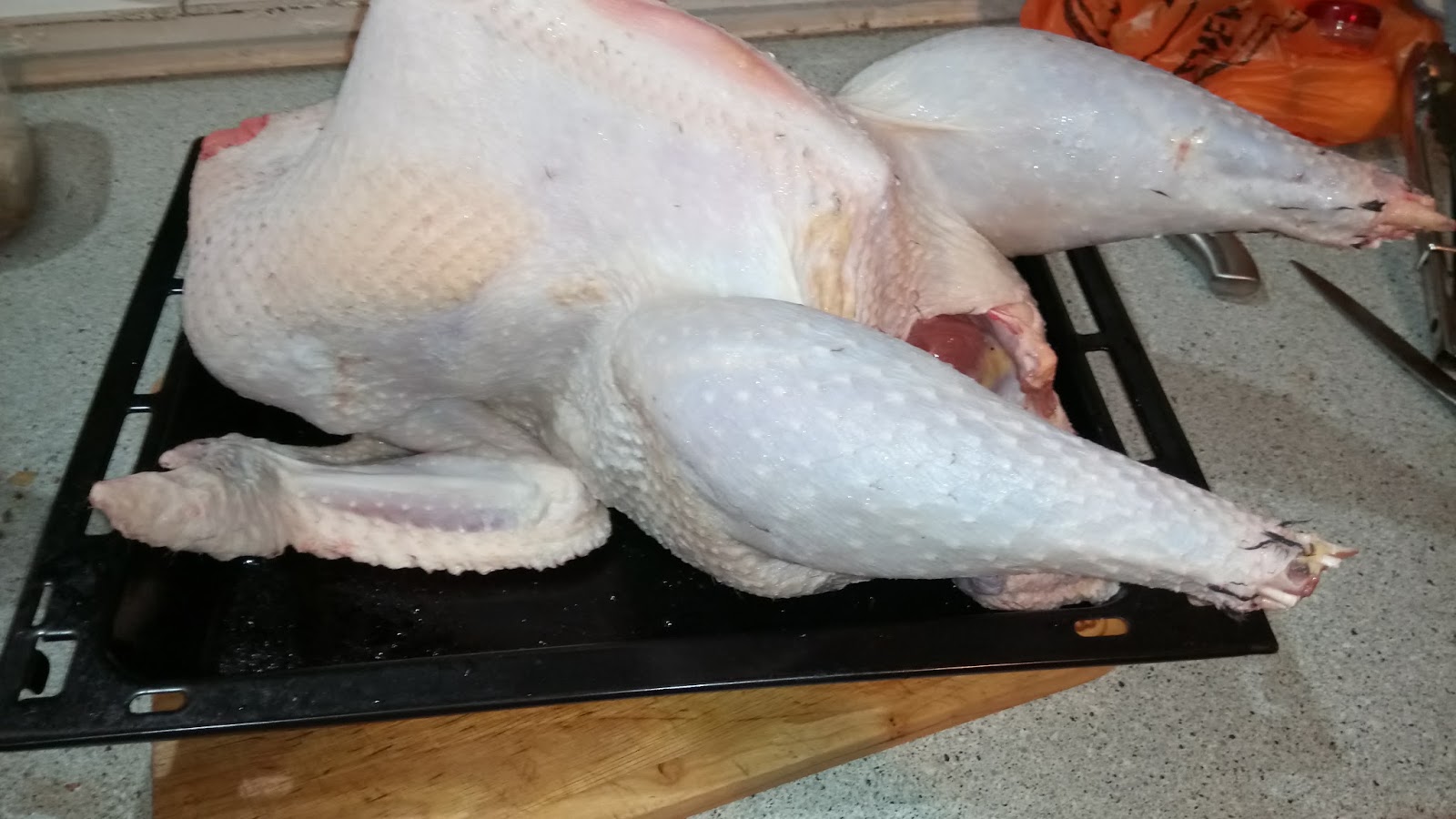
Gutting was not what I expected.  Bits were easy, but I tore the gullet and spent a bit of time washing fine grains of mash and grass out of the neck.  I also tore a small hole in the tract between intestine and vent and spent even longer washing that off - in the end I cut out the bits that had been in contact with it.

After probably three hours, I had a plucked, dressed and very well washed turkey.  Dressed weight is 12kg, it's a little bit too big for my largest roasting dish, but hopefully it'll shrink a little in the cooking.

Ready for stuffing, trussing and roasting.


Sunday, 24 July 2016

Turkeys

Hubby came home from work a few months ago and asked if we wanted turkeys.

After hearing from him several times over the last few years that we were never getting turkeys, I was quite surprised to hear this from him.

One of his workmates has a friend who has 60 turkeys free-ranging and they were becoming a problem and needed to go.  Because she'd started with two originally, they were all her babies and she didn't want to eat them or know about it if anyone was going to eat them.  She wanted to be able to tell herself they were going off to be pets for someone who would love them like she did.  She'd tried selling them on TradeMe, but because of the recent push for certified humane animal breeders and sellers, her ads kept getting removed.

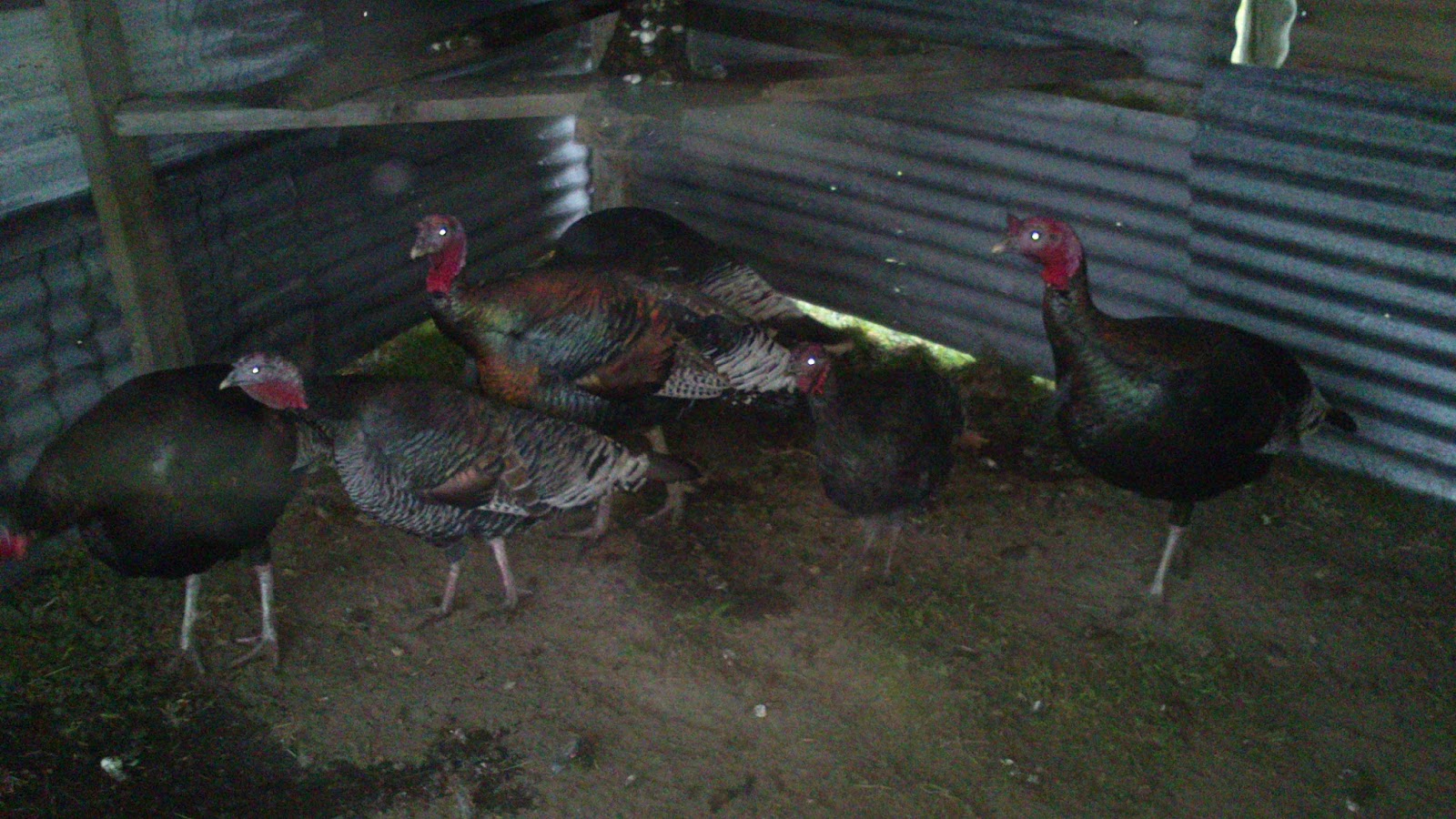
We talked about it for a few weeks and I rang her.  We converted a pen in a paddock to a turkey house thinking that if we clipped wings, the deer fencing would be sufficient to contain them.  Then we finally went to pick them up with a covered box trailer.  The theory was that if we threw some food in, they'd go in after the food.  I think it took about half an hour for any of them to brave the trailer - after the roosters had been in and out a few times.  After a while, we figured we had all in there that we were going to get and shut up the trailer.  We got six turkeys, four boys and two girls.  And two roosters who escaped as soon as we got home.

Six turkeys investigating their new house.

In my head, I knew turkeys were big.  I hadn't physically seen a turkey since I was a small child though and then they seemed like ostrich size.  I was still surprised by just how big they were.  Then seeing how high they could jump (even without flying) meant that the deer fencing would not be sufficient to keep them contained.  The paddock next door to their paddock had been planted in green feed, mostly oats and kale.  I'm fairly confident our neighbour would shoot and eat any that he found in his greenfeed and I couldn't blame him honestly.

We'd planned to shut them in their newly built house for a couple of days anyway, like I do with any new chickens I get, so they get to know where home is.  The need to create a covered run meant they got to stay confined for a week while the run was created out of deer fence waratahs (or Y posts as they're more correctly named) and 2m wide chicken wire.  Dad and Hubby sat down and did the maths to figure out what would be the best size, utilising existing fencing to get the most area out of 100m of chicken wire (including roof).  Then they discovered that the roll of chicken wire was only 50m and they'd run out with the run only half roofed.

Exploring the covered run.

Finishing the run took a little longer than expected, or rather it took longer than planned because delays, dramas and holdups are pretty much expected these days.  But the turkeys seemed to like their new run and spent a lot of time exploring it.

I worried a little on and off as their wattles seemed to be going white.  In chickens, white comb and wattles are a sign of ill health and I assumed that turkeys were the same.  I spent some time on google but couldn't really find anything definitive - one website suggested that wattle colour in turkeys was more a sign of their mood.

Pale wattles 
Last weekend, ten more joined them.  The lady I mentioned earlier has been feeding the turkeys in a caged trailer for the last month or so and they're used to going into the cage on the trailer for food.  It made shutting in more turkeys a piece of cake.  She and her hubby thought they'd even enjoyed the hour drive to our place.  They'd been quiet but still alert and watching everything around them.

This is the four boys just as the new turkeys were joining them.
As they were backing the trailer up to the turkey run, the six we already had found it quite threatening.  The girls rushed off and hid in the house, while the boys puffed themselves up, tails fanned, wattles bright red and snoods hanging halfway down to their chests.  The new turkeys coming to join them had come from the same place they had, they'd only had approximately a month apart, but obviously the pecking order had to be re-established.  There were lots of fanned tails, red faces and thrumming noises over the next hour or so.  

Pecking order being sorted
They seem to have it mostly sorted out now, but our head count shows ten boys to six girls, so those numbers will need some serious adjusting very soon.  A friend has mentioned she has another friend who has turkeys, so I may try and arrange a swap for some boys just to get some fresh bloodlines in - I think all of mine are related.  I'm fairly sure the lady we got them from said she started with one pair and from them came the other 58.

She also told us that the facial colours are a sign of mood.  Red wattles and blue-purple round the eyes is when they're agitated, upset or fighting for dominance.  Pink and white is a fairly relaxed and normal state.

We did managed to drive the escaped roosters towards the chook run.  Once they realised that there were 40 or 50 odd hens on the other side of the fence, they were no longer worried about me chasing them, they suddenly started posing and nonchalantly showing off for the girls.  One wouldn't go into the chook run for another two weeks.  He nearly became dinner as he'd start crowing outside our bedroom from about 4am, but we did eventually get him in there.